
A story, not a checklist
Understand why the city looks the way it does, from princely origins and royal ambition to communist transformation, the 1989 Revolution and the capital of today.
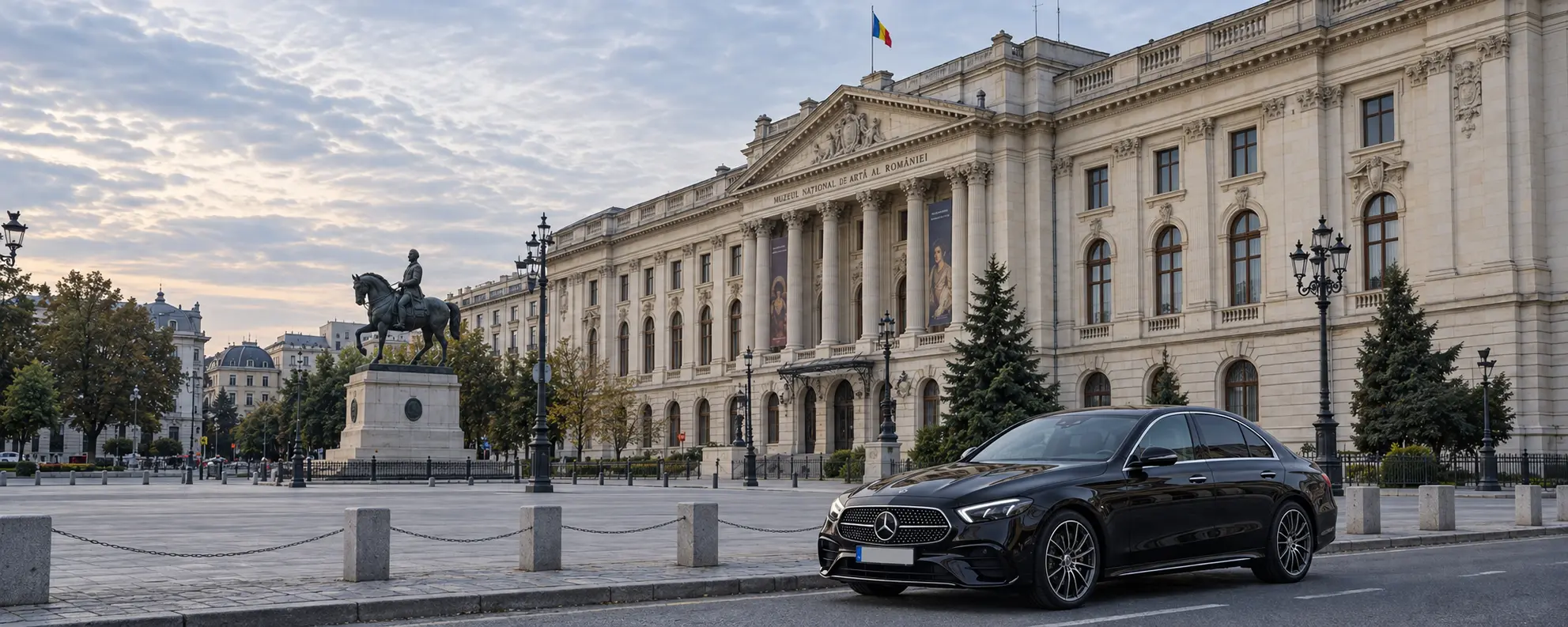
Premium private tours in Bucharest
Explore Romania’s capital with a private professional guide-driver, a premium Mercedes and an itinerary that adjusts to your interests—not a group timetable.
The experience
Bucharest can move from Belle Époque façades to monumental communist architecture in a single avenue. Orthodox churches appear between modern offices, elegant villas survive beside apartment blocks, and quiet gardens sit only minutes from some of Europe’s largest civic spaces. A private tour connects those contrasts through the people, decisions and turning points that created the city you see today.
Begin with the royal and cultural city around Calea Victoriei, the Romanian Athenaeum and Revolution Square. Continue toward the old commercial streets, then read the vast communist civic centre as both architecture and political ambition. The route does not treat these as unrelated landmarks: it explains how each period altered the city without completely erasing what came before.
The experience can lean toward architecture, royal history, Jewish heritage, the 1989 Revolution, local neighbourhoods, museums or contemporary life. Your Mercedes keeps longer transitions comfortable; carefully chosen guided walks bring the most revealing streets and details into focus.
Understand why the city looks the way it does, from princely origins and royal ambition to communist transformation, the 1989 Revolution and the capital of today.
Spend longer with architecture, political history, museums, neighbourhood life or food. Stops can change with weather, traffic, opening hours and your energy.
Begin and finish at your hotel, residence, airport or agreed Bucharest address, using short guided walks only where they genuinely improve the experience.
Four Bucharests
The most rewarding tour does not choose one version of Bucharest. It shows how the princely, royal, communist and contemporary cities continue to share the same streets.
Along Calea Victoriei and around the Romanian Athenaeum, palaces, hotels and cultural institutions reveal the ambitions of nineteenth- and early-twentieth-century Bucharest. French-trained architects brought Beaux-Arts, Art Nouveau and later Art Deco ideas, while Romanian patrons used architecture to express the confidence of a modern kingdom.
Lipscani, Stavropoleos Church, the old inns and the remains of the princely court preserve a denser, more intimate Bucharest. Here the story turns toward trade routes, Ottoman influence, fires, rebuilding and the commercial life that connected Wallachia with Central and South-Eastern Europe.
The Palace of Parliament and the immense civic centre cannot be understood through scale alone. Their construction displaced historic neighbourhoods and embodied Nicolae Ceaușescu’s political project. Revolution Square then brings the story to December 1989, when the spaces of state authority became stages of public resistance and change.
Beyond the monumental centre, Cotroceni, Dorobanți, the Village Museum and selected residential streets reveal a city of gardens, villas, cafés and ordinary routines. This is where visitors begin to understand contemporary Bucharest: imperfect, energetic and continually negotiating with its past.
Your route
This is a suggested flow, not a rigid script. The four-hour tour gives a coherent first understanding of the capital; the eight-hour experience allows a museum or interior visit, a local lunch and more neighbourhood detail.
Adapt this journeyYour guide-driver discusses the day’s priorities before departure and introduces the city as you move toward its historic centre.
Read the capital’s grand avenue through its palaces, cultural institutions, restored façades and the events of December 1989.
Walk a carefully chosen section of the old city, with stops around Stavropoleos, Lipscani, the princely-court area or the historic inns according to access and interest.
Understand the political ambition, urban destruction and human cost behind the monumental axis. Interior admission can be planned separately when available.
On a full-day tour, choose a deeper interior visit: traditional regional architecture in the open-air Village Museum or the private world of Romania’s communist leadership, subject to opening and tickets.
Add a restaurant, historic café, market or residential district that matches your interests rather than losing time at a generic tourist stop.
Return to your hotel or continue to a restaurant, museum, meeting point or airport when this has been included in the confirmed plan.
The VIP Drivers standard
Private means the route, timing and pace belong to you. Before departure, you receive a clear plan and written confirmation of the service.
Choose a focused four-hour introduction or a fuller eight-hour day. Your quotation confirms the route, vehicle, requested admissions and collection point.
One professional manages both the road and the interpretation, with the depth adjusted to what genuinely interests you.
A discreet, climate-controlled E-Class, V-Class or S-Class selected for your party.
No strangers join your tour. The vehicle and the day belong to your group.
Discuss your date and preferences directly on WhatsApp before confirming.
Designed for
Good to know
Yes. Tell us whether you prefer history, architecture, local life, museums, food or a balanced first introduction. The route is shaped around those priorities.
It combines both. The Mercedes makes movement between districts comfortable, while short guided walks are used where the city is best understood on foot.
Collection is normally from your Bucharest hotel, residence or another agreed city address. Airport collection can also be discussed when it fits your schedule.
Often, yes. Send your available time, airport or meeting details and luggage requirements so a realistic route with sufficient time margin can be proposed.
Four hours covers the essential historical sequence through selected driving stops and short walks. Eight hours allows a slower pace, a museum or interior visit, a lunch pause and more time in a neighbourhood beyond the monumental centre.
Interior visits depend on the official programme, security requirements and ticket availability. When requested early enough, the visit can be considered in the itinerary; otherwise the exterior and surrounding urban transformation are explained in depth.